
The Ultimate Guide to Bodyweight Exercises Eastleigh for Toning & Strength

Bodyweight exercises use your own body as resistance, making them accessible, adaptable, and effective—no equipment required. They’re ideal for home routines, travel, or supplementing gym work.
In this guide, we’ll explore how to use bodyweight training for toning, how to structure a programme, progression principles, and how non-surgical aesthetic treatments can complement your efforts.
Why Bodyweight Exercises Eastleigh Work So Well
Benefits
- Accessibility: Do them anywhere—home, hotel, park—since you don’t need special gear.
- Functional strength: They inherently engage stabiliser muscles, balance, and coordination.
- Progressive adaptation: You can increase difficulty via tempo, leverage, volume, or advanced variations.
- Low cost / low barrier: No gym membership, no bulky equipment, minimal setup.
Considerations
- As you get stronger, pure bodyweight may plateau for some muscle groups—variation or added resistance may become necessary.
- For toning (as opposed to pure strength), consistency and good form are key.
Sample Bodyweight Exercises Eastleigh & How to Use Them

Below is a selection of effective bodyweight movements. You can mix and match these into circuits or workouts.
Exercise Target Muscles Notes / Modifications
Push-ups (standard / inclined / knee) Chest, shoulders, triceps, Core Use incline or knees to reduce load; gradually lower incline.
Dips (bench or chair) Triceps, Chest, front delts Use a stable chair; feet closer → harder; feet farther → easier.
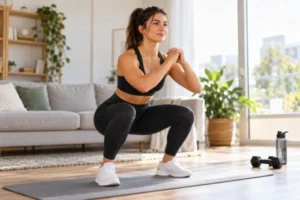
Bodyweight squats / split squats/pistol progressions Quads, glutes, hamstrings Use a chair or Support for balance; partial range at start.
Lunges / step-ups Legs, glutes, stabilisers Use a low step initially; hold onto Support if needed.
Plank/side plank/plank variations Core, shoulders, stabilisers Start from knees or incline if full plank is too intense.
Glute bridges/hip thrusts: Glutes, hamstrings, lower back. Progress to the single-leg bridge for difficulty
Mountain climbers / high plank taps/plank shoulder taps Core, shoulders, hip flexors. Go slower initially, focus on control.
Bicycle crunch / reverse crunch/leg raises Abdominals, obliques Support lower back; bend knees as needed.
How to Structure a Bodyweight Exercises Eastleigh Program
- Warm-up (5–10 min)
- Dynamic mobility, joint rotations, light movement (arm circles, leg swings).
- Main sets/circuits
- Choose 4–6 exercises covering push, pull (or variation), legs, and Core.
- Perform in circuit style (one after another) or in straight sets.
- Start with 2–3 rounds, 8–20 reps (or timed sets like 30 s), depending on your level.
- Rest 30–90 seconds between sets or rounds, depending on intensity.
- Cool-down & stretching
- Static stretches for muscles used; foam rolling or mobility work.
- Progression methods
- Increase the number of reps/sets.
- Slow down tempo (especially eccentric phase)
- Change leverage (e.g. incline → standard → decline)
- Add pauses or isometric holds.
- Combine unilateral work (single-leg, single-arm)
- Consistency & variation
- To avoid plateaus, rotate your exercises every 4–8 weeks. Incorporate rest and recovery days.
Non-Surgical Treatments That Can Help Tone Your Body Alongside Bodyweight Exercises Eastleigh
While bodyweight training is foundational, aesthetic or contouring clinics often offer non-surgical modalities that can complement your efforts—especially for stubborn fat, skin laxity, or trouble areas. These treatments are adjuncts, not substitutes for exercise and nutrition.
Here are some commonly offered treatments and how they may help:
Treatment: What It Does / Mechanism, Best Use Cases & Considerations
Cryolipolysis (“fat freezing”) Controlled cooling to induce fat cell apoptosis. Suitable for localised fat pockets (abdomen, flanks, arms). Needs multiple sessions; not for dramatic weight loss.
Aqualyx / Fat-dissolving injections: an Injectable solution that breaks down fat cells. Useful for small, resistant areas (e.g. under the chin, inner arms). Must be administered by a qualified practitioner.
Radiofrequency (RF) skin tightening: Heating the dermal and subdermal layers to stimulate collagen/elastin, helping firm mild to moderate skin laxity after weight loss or as contouring Support.
Ultrasound cavitation / HIFU Ultrasound waves target deeper fat layers or stimulate tightening. Often used on the abdomen, thighs, or arms; suitable for non-invasive contouring.
Electrical Muscle Stimulation (EMS / ESM) Electrical pulses stimulate muscle contractions. It can support muscle tone when movement is limited, or for specific regions.
Combination / hybrid treatments: Using two or more modalities together (e.g. RF + EMS, Cryo + RF). Synergistic benefits—fat reduction + skin tightening + tone enhancement. All treatments are safe and FDA-approved.
Important disclaimers & tips:
- Results tend to be gradual and modest, mainly when used alone.
- These are complementary tools—your most significant gains still come from consistent training and diet.
- Always choose clinics with medical oversight, credentialled staff, and a solid track record.
- Disclose your medical history (skin conditions, implants, circulatory issues, medications) to avoid contraindications.
- Ask about pre-treatment assessments, post-treatment protocols, and follow-up sessions.
FAQs (Frequently Asked Questions) Bodyweight Exercises Eastleigh
Q1: Can I see significant body shaping using just bodyweight exercises?
Yes—especially early on or in beginners, bodyweight work can deliver noticeable tone, strength, and definition. Over time, you may need to add resistance or variation to continue progressing.
Q2: How often should I do a bodyweight routine to see results?
Aim for 3–5 sessions per week, depending on your recovery and schedule. Even 20–30 minutes per session can lead to gradual improvement over 8–12 weeks.
Q3: When is it appropriate to use non-surgical treatments?
These are most effective after you’ve established a base level of fitness and are close to your target weight or shape. They can help with refinement, stubborn areas, or skin tightening when further changes via exercise are slow.
Q4: Are non-surgical treatments safe? Any risks?
When done by qualified professionals, many are relatively safe. But there are risks: bruising, swelling, discomfort, skin sensitivity, asymmetry, burns (rare), or nerve irritation. Always consult with a medical professional first and choose reputable providers.
Q5: How many sessions will I need for contouring or toning treatments?
It depends on the modality, the treatment area, and the individual’s response. Often, 1–3 sessions are recommended, followed by maintenance. Clinics will tailor a plan to your needs.
Q6: Will treatments like cryolipolysis or RF replace exercise?
No. These treatments complement your fitness efforts. They help target specific trouble zones; long-term results depend on your movement, strength, and consistent nutrition.
Q7: How soon after starting bodyweight training can I try non-surgical treatments?
Once you’ve been consistent (e.g., 8–12 weeks) and your weight or body shape has stabilised, it’s a safer time to consider adjunct treatments—so you can see how much more natural progress you might still get via training first.
Q8: What metrics should I track to monitor progress?
Don’t rely solely on the scale. Track:
- Body measurements (waist, hips, arms, thighs)
- Progress on exercises (e.g. number of push-ups, hold times)
- How your clothes fit
- Photos (monthly)
- Energy, posture, functional ability
For More Information Call Us On This Number 03300 100 576